
A buyer has two offers. The isolate costs more per kilogram, and the concentrate can arrive sooner from a nearby warehouse. At the bench, the technologist has time to break up lumps and both powders deliver the target protein. On the line there is a fixed hydration window. If the new powder leaves residue in the tank or produces sediment after processing, the price difference may become the least expensive part of the decision.
Put both protein figures on a common basis, then calculate the amount of each powder needed as delivered. Trial the candidates under your real mixing, heating and storage conditions. For a company deciding whether to manufacture isolate or concentrate, those same acceptance criteria can shape the product brief and the requirements for an industrial line.
What distinguishes soy isolate from concentrate
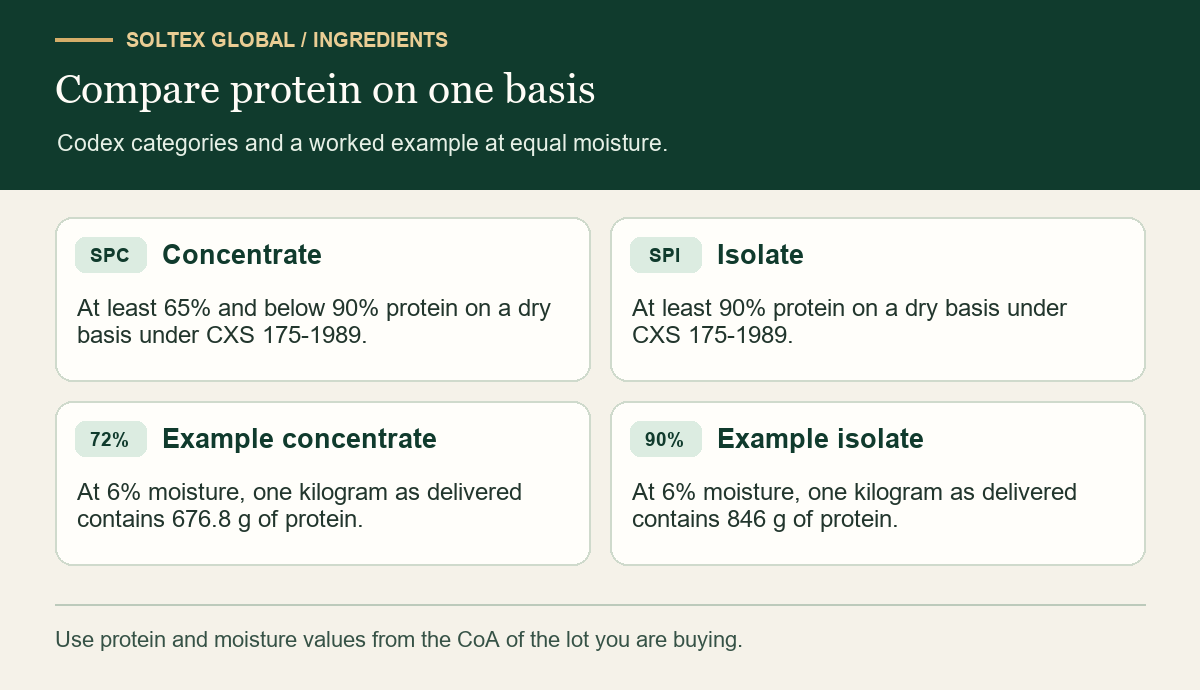
Under Codex CXS 175-1989, soy protein concentrate has at least 65% and less than 90% protein. Soy protein isolate starts at 90%. The figures use nitrogen multiplied by 6.25 on a dry-weight basis, with added vitamins, minerals, amino acids and food additives excluded from the standard's calculation. When you receive a supplier's certificate, confirm the moisture result, analytical method and reporting basis before comparing offers. Codex General Standard for Soy Protein Products
A higher proportion of protein leaves less room for other material in the dry ingredient. That matters when a serving has a fixed mass, when the recipe already runs close to its solids limit, or when the target protein requires more powder than the process can handle. A formulation with room for more solids may accept a larger addition. Its technologist still needs to establish what happens to viscosity, colour, water retention and taste with the chosen commercial grade.
Keep the other lines of the specification next to the protein value. If two offers also differ in moisture, grade or processing history, each difference can affect the trial. Record whether the sample was given additional treatment to change functionality and ask if that treated grade will be supplied at production scale. The information helps when two lots that fall in the same Codex category behave differently in the mixing tank.
Calculate the dose and cost on the same basis
Take two illustrative lots. The isolate is 90% protein on a dry basis, the concentrate 72%, and both powders contain 6% moisture. For the isolate, multiply 0.90 by 0.94 to get 0.846 kilograms of protein per kilogram as delivered. The concentrate gives 0.6768 kilograms. Providing the same quantity of protein takes about 1.25 kilograms of this concentrate for each kilogram of this isolate. These numbers illustrate the conversion. Use the measured moisture of both candidates for an actual purchase.
The extra quarter kilogram adds other solids as well. Check the remaining allowance for portion weight, viscosity, water addition and mixing time. A drink trial may need a comparison at the same protein content, followed by one in which total solids are controlled as well. For a shaped or water-binding product, look at how the dose changes the conditions under which you measure texture and finished yield.
Divide the cost per kilogram of powder by the protein fraction as delivered to calculate the ingredient cost per kilogram of protein added. Then record the delivered price, storage and handling conditions, actual dose, changeover time and any loss in the trial. Tie the commercial comparison to a kilogram of product the quality team accepts. Where a grade has yet to run, keep that part of the cost sheet open until the production observations are available.
Before replying to an offer, record the conditions under which the cheaper powder still makes sense. In the example, the additional concentrate must fit the solids and loading limits and reach the acceptance target after storage. If the recipe must change to achieve that, include the development time in the comparison. This gives procurement a specific follow-up to put to the supplier before it commits to a larger order.
Check the behaviour that matters on your line
Wetting, solubility and sediment
A laboratory solubility result belongs to the concentration and method used to obtain it. Ask for pH, temperature, preparation, mixing time and the way the laboratory defines the soluble fraction. The nitrogen solubility index and protein dispersibility index use different test procedures. If the certificate lists one and the recipe qualification calls for the other, ask the supplier for data from your agreed method or run both candidates under one protocol.
A powder can wet slowly and still give a uniform sample after long bench mixing. Put the actual hydration time in the trial and note residue on the equipment and the state of the blend after the mixer stops. For a drink, document sediment or a surface layer after storage. Record the result before and after the heat treatment. Decide whether acceptance depends on stability at rest, re-dispersion after agitation, or both. A returned pack cannot be compared easily with a specification that says only “good solubility”.
Schmid and colleagues compared commercial powders from one concentrate and five isolate products. The tested grades varied in powder properties and solubility under the conditions used. The study also identified limits in extrapolating to concentrated systems and heating and cooling processes. Use that evidence to choose what to test while taking your own line measurements to qualify the grade. Study comparing commercial soy protein concentrate and isolate powders
Water holding and structure
For a filling, a shaped mass or an emulsion, check the properties that determine whether it can be sold. That could be liquid released into the tray, the cutting force after the usual treatment or how long a portion holds its shape. Note how long the protein is exposed to water before salt and other ingredients enter. Keep the current addition sequence in the first comparison. If the supplier recommends another hydration method, schedule a separate run so the result tells you what changed.
Choose a measurement that reflects a defect already seen on the line or in a customer return. For a product that releases water in the pack, record the mass of free liquid after an agreed holding time. For a chilled drink, check sediment under the normal storage conditions. For a shaped product sold for cooking, measure texture after the ordinary preparation. Give the method, inspection time and acceptable range to the team that handles incoming materials.
Flavour and appearance after processing
Check flavour in the actual product using coded samples where practical. Record the lot and the heating conditions. Results in a neutral shake give limited information about a salty or acidified formulation. Where colour or odour after storage is important, use comparable packages and the same time after opening. Provide a reference for an acceptable lot so a shift can judge the result without having to reconstruct the original sample trial.
Trial two commercial grades under the same conditions
Run the current formula as the reference and connect every sample to a raw material lot and a process stage. The first comparison can use the same amount of protein. If the shift in total solids prevents a clear interpretation, keep a separate series where solids are controlled. Decide how the trial material will enter the line, what will mark the switch back to normal production and who can stop the trial if an agreed acceptance limit is crossed.
| Checkpoint | Evidence to record |
|---|---|
| Incoming control | Grade, lot, sampling date, moisture, protein content and the methods used. |
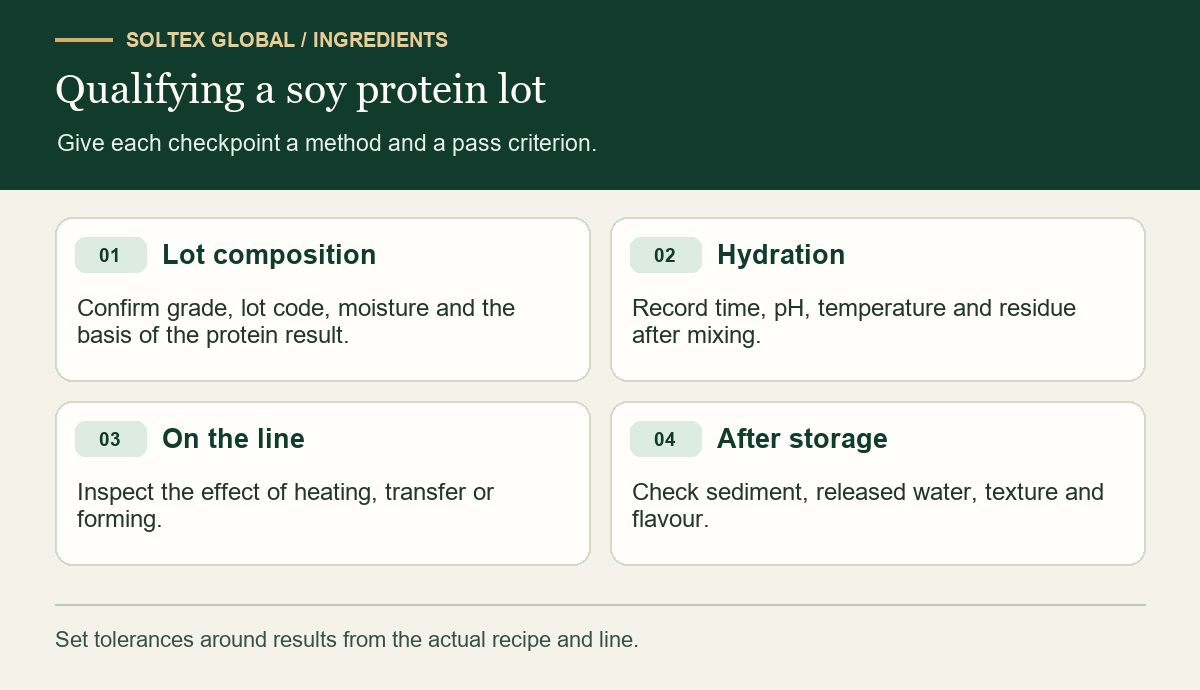
| Mixing and hydration | Time, temperature, pH, lumps, tank residue and viscosity under the agreed method. |
| Critical operation on the line | Changes after heating, transfer, filling or forming. |
| Storage | Sediment or free liquid, texture, odour and comparison with the approved reference. |
If the first and last portions from the tank differ, keep their sampling times. A batch average can hide the part that took too long to hydrate or settled before filling ended. The buyer will also need to know how much is available for the next run and whether the commercial lot will have the same grade and manufacturing history. Keep a control sample when the plant's traceability and storage procedures allow it.
Set the specification before you choose a production line
If you are planning a factory, start from the powder you expect to sell. Further separation of protein changes the material balance, including the composition of side streams and the material that goes to drying. A single feedstock lot and one trial are a thin basis for sizing a plant intended to run on several sources. Request composition data from distinct lots and establish how moisture and protein were measured. Your process team can use that information to define the input range for an engineering trial.
Separate product quality from equipment throughput in a line specification. State where protein recovery is measured, how material losses are defined and which information is needed from intermediate streams. Specify whether raw material preparation, standardising the finished powder, packing, cleaning and side-stream treatment fall inside the tender. Express input and output quantities on the same basis for competing proposals. A tonne of feedstock and a tonne of finished dry powder belong in different rows.
Before selecting a dryer, agree how the sample will be handled after drying and storage. A trial with material tested before drying gives only part of the functional profile. Request an application trial on powder from the pilot run. Record the dry powder's hydration time, quality after the critical heat step and results after the usual hold or storage. Define lot sizes, sampling and the methods used for acceptance before equipment is sized around the result of one trial.
Ask the engineering team for practical operating limits as well as a target output. These include the effects of changing feedstock, process water and heat demand, and the time needed to return to stable production after cleaning. Link each value to a trial result or a documented design assumption and show which ones will be checked at commissioning. Reserve time for an agreed repeat if the first result falls outside specification. Those terms give the investor a clearer basis for comparing proposals that cover concentrate, isolate or both.
Turn the trial report into purchasing terms
Obtain the technical specification, a current certificate of analysis, manufacturing information, packaging details and the supplier's change notification procedure. Have your quality team check the allergen documentation and other evidence needed for the intended market and product. Put measurable acceptance criteria in the specification, with the method and an agreed route for independent testing where the plant cannot make a measurement in house.
Keep the reason for each important criterion next to the term. If the limit on sediment came from an unstable refrigerated trial, attach the conditions and record of that defect. If the requirement is finished yield after forming, define where that figure is measured. Receiving and quality can then decide together whether the next lot is acceptable and who resolves a conflict between the supplier certificate and a plant result.
For ingredient purchasing, use the Soltex Global soy protein isolate product page to ask about a specific grade. If your objective is to make the ingredient, review the soy protein production technologies. The EPC/EPCM engineering team can discuss where product requirements sit within a scope that covers feed preparation, processing, drying and utilities.
In your first enquiry, name the product, working dose, target protein content, allowable hydration time and known process constraints. Describe what the current powder does that interferes with production, such as sediment after chilled storage or a blend that becomes too viscous for the pump. Add the delivery market and the sample quantity if they are known. A supplier can use those details to suggest a trial and agree measurable acceptance conditions before you order a commercial lot.