
A new pectin lot arrives with the same degree of esterification as the sample you approved. During a trial, the filling starts to thicken in the holding tank. It still has to pass through a pump and a depositor. The certificate gives you a useful composition result. To find out why the filling set early, the technologist also needs the grade's setting characteristics and a record of what happened in the batch.
Use the degree of esterification to narrow the grade family. A conventional, high-solids fruit gel is a reason to start with high-methoxyl pectin. A reduced-sugar filling warrants testing a low-methoxyl grade and its response to calcium. Approve the actual grade against the heating, transfer, filling and cooling conditions on your line. That is where a promising bench sample may behave differently from a lot you can use every week.
What the DE entry tells you
Degree of esterification, abbreviated DE, describes the proportion of carboxyl groups on galacturonic acid residues that are esterified. In ordinary food pectin those ester groups are mainly methyl esters. High- and low-methoxyl grades are generally separated around 50% DE. If a grade specification sits close to the boundary, ask the supplier to identify the grade family, analytical method and tolerance for that material.
A certificate entry of 65% DE helps identify a pectin grade. Dose and setting time still have to be established for the product. Grades in the same family can differ in chain structure, the materials used to standardise the commercial blend and behaviour in the presence of calcium. An experimental comparison of LM pectins in a similar DE range found differences in calcium gel strength associated with molecular structure. That is a practical reason to qualify the supplier's actual sample. Experimental study of calcium gel properties in LM pectin
Ask for degree of amidation, or DA, when a grade is amidated. It describes the proportion in amide form and belongs on a separate line of the specification. If your current specification lists DE alone, a proposed move to an amidated grade calls for checking its behaviour at several relevant calcium levels. The JECFA entry gives a reference for the identity of food pectins. Your own product and process specifications set the conditions for the line trial. JECFA Pectins specification for INS 440
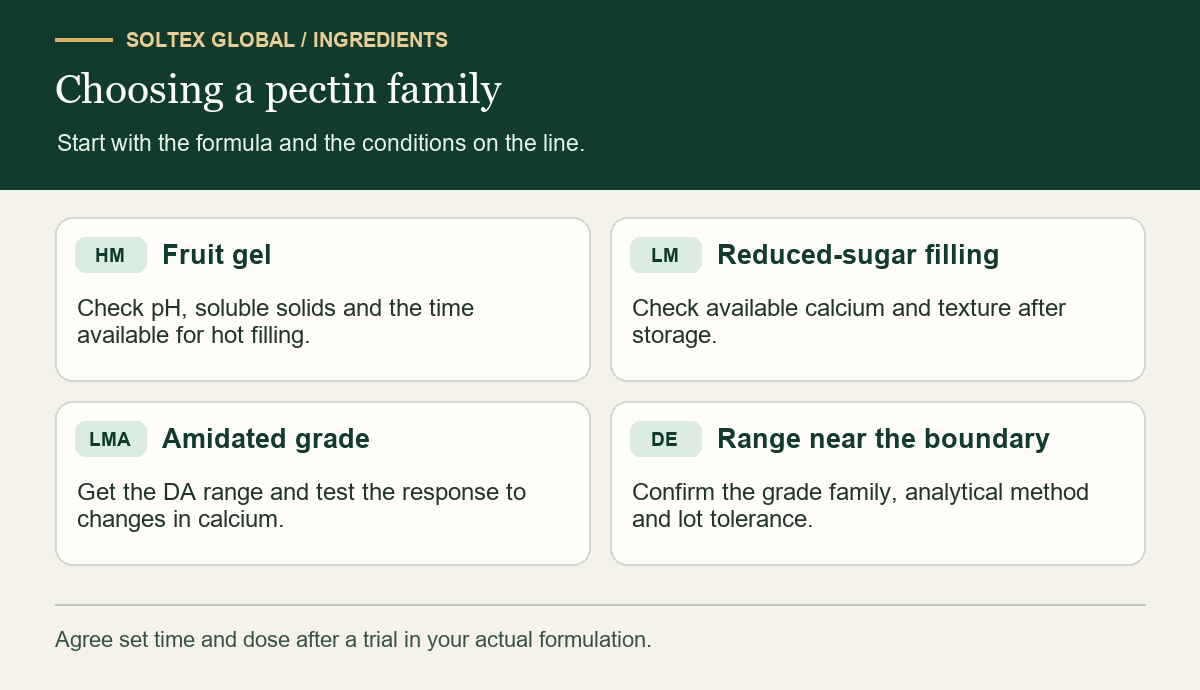
Three cases that change the choice of grade
A conventional jam or hot-filled fruit preparation
Acidity and soluble solids matter to HM gel formation. Start with the blend that actually reaches the filler. A fruit puree before concentration, syrup in a cooker and the finished preparation can give different readings. Record the pH and refractometer results at a specified point, the sampling temperature and the time the batch spends in the holding tank. This gives the next person a place to reproduce the conditions associated with the defect.
When a supplier offers rapid- or slow-set pectin, ask how the setting result was obtained. On a line where one cooker feeds two fillers, sample the first and last packs from a common batch. The first pack begins cooling soon after filling. The last portion may spend longer in a hot buffer and arrive at a different temperature. Comparing their texture the next day is a useful way to establish whether both ends of the filling window are acceptable. Experimental comparison of HM pectins with different DE values
Some teams try to regain filling time by adjusting product acidity or holding temperature. That can affect product quality and the way the existing process was validated. Separate the effect of the pectin grade in a controlled formulation trial before making a line-wide change. If the plant eventually changes a set point, preserve the earlier data. The process team can then identify the change that removed the defect and determine which operating limits need review.
A reduced-sugar filling with variable calcium
LM pectin opens up options at lower soluble solids. Available calcium plays a substantial part in forming the structure. Trace the contribution from process water, fruit, dairy ingredients and added salts. Precisely weighing an added salt gives one piece of the picture. A new fruit lot can shift the result at the same dose. Include the relevant upper and lower conditions in your trial if they occur during normal purchasing.
Structure that develops too early may show up as lumps near the addition point or resistance in a transfer line. Another batch may pass through the filler and release liquid in storage. Record where the pectin and calcium enter the process, the mixing time and temperature, and the result in the pack. In the next run, vary one agreed factor at a time. That makes it possible to judge whether the first failure was connected to dispersion, calcium availability or the time left for filling.
Put conventional LM and amidated LM candidates through the same product matrix. Look at texture when the raw material is near both ends of its normal range. A plant with stable water and a tight puree specification may need fewer screening runs. A plant that cooks seasonal fruit from several suppliers needs a grade it can qualify across ordinary lot variations without asking operators to adjust the process with each delivery.
An acidified drink that needs to stay pourable
Some grades are selected to help stabilise a dispersion that is meant to flow. For this application, score separation, sediment, filling viscosity and consistency after storage. Include the actual order of mixing and the heat treatment. If a supplier's data come from a fruit gel, ask for a test in the relevant matrix or agree a separate trial. The Soltex Global pectin product page is the starting point for requesting a grade specification and discussing the application.
What to put on the supplier request
The product specification gives the agreed grade, allowable ranges and methods. A certificate of analysis gives the results for the delivered lot. Obtain both and compare the grade code on the sample, bag and certificate. Ask how the supplier will communicate a change of source, manufacturing site or blend standardisation. A small formulation change can matter to a factory that has qualified the material within a narrow operating window.
| Document field | What makes two offers comparable |
|---|---|
| Grade family, DE and DA for an amidated grade | Method, acceptable range and the rule for a borderline result. |
| Setting and gelling information | Formula, temperature, hold time and measurement procedure used in the test. |
| Composition of the supplied blend | Standardisation ingredients and fit with the buyer's formulation constraints. |
| Calcium reactivity of an LM grade | Calcium conditions in the test and the response when those conditions change. |
| Lot number, storage conditions and shelf life | Traceable samples and a procedure to resolve a document or lot mismatch. |
One supplier may report gel strength after a full day. Another may report viscosity as soon as the mix comes off the cooker. Ask for fresh samples under a common method before comparing those numbers. At the specification stage, also agree what happens if the plant obtains a result close to a moisture limit. A documented procedure for sampling and repeat measurement is easier to apply before a truck is waiting for an acceptance decision.
Give procurement and the laboratory one reference sample, together with a record of how it was stored. When a candidate is introduced, keep enough approved material available to return to the current formula if the trial fails. The scheduling team needs to know who can stop the trial and how the line returns to the production order. The quality team should check the documents required for the intended product and market before they become purchasing conditions.
Run a trial the next shift can reproduce
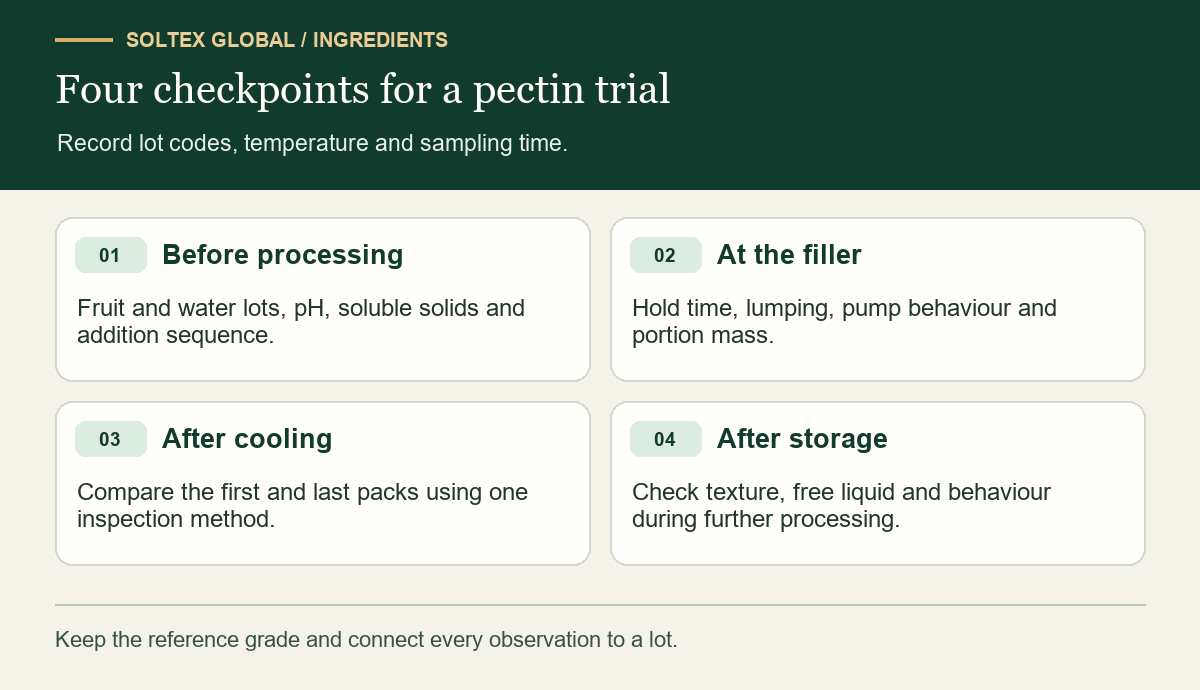
Start with the current formula and a control lot the factory knows. The reference remains useful when you are trying to correct its shortcomings. If the control behaves differently on the day, inspect the raw material, mixing sequence and measurement conditions before passing or failing the candidate. Record the lot codes of ingredients that may affect gelation, including the water source where it changes between shifts or seasons.
Use the same mixing, temperature profile and sampling times for the first comparison. Give pH a measurement temperature and a process location. Record the method and product composition alongside a °Brix reading, particularly when the formula departs from the normal sugar system. Write down when the pectin enters, where the calcium source goes in, and how long the sample cools before the control measurement. Express each dosage against a clearly defined total batch mass that operators can use for scale-up.
Set separate acceptance criteria at filling and after storage. On the line, check lumping, pump transfer and the consistency of each portion. Later, evaluate texture, free liquid and how the product holds up when it is handled or processed. A filling sold for baking or frozen distribution deserves that step in the trial. Give every observation a method and time point. A specific defect such as free liquid around a thawed portion can be recognised and recorded by another shift.
A bench mixer can screen candidates before taking production time. Put the finalists through the operation that puts the greatest strain on the recipe. On one line it may be hot holding before deposition. On another it may be the cooling stage on a warm shift. Measure the first and last packs if the filling window is in question. Keep the timing sheet next to the quality readings so the result can guide a second run without relying on the memory of the person who ran the first.
Compare the cost per kilogram of accepted product
Buying teams see a price per kilogram of powder. Production needs the cost of a batch that passes. Put dosage, supporting ingredients, repeat processing and losses during line start-up in the same comparison. Add observations for each candidate after trialling it. A blank cost field for an untested grade keeps the decision open. A zero can look like a verified absence of losses and create a false saving in the decision sheet.
Record the reason the accepted grade won. Two samples might meet the storage texture target, with one still filling cleanly after the maximum hold. That observation gives a defensible reason to choose it for the current equipment. The procurement team can use the decision record at renewal. The technologist can repeat the critical part of the trial when a change of formulation, supplier or packaging affects the operating window.
If variability originates further upstream, review extraction, purification and standardisation with the ingredient producer. The overview of Soltex pectin production technology provides context for that discussion. For a new plant or an equipment change, put the acceptance conditions into the EPC/EPCM engineering scope and identify where each property will be measured on the line.
Send the conditions with the sample request
Describe the product, current grade, target texture, recipe constraints, pH and soluble solids at a defined point. Add known calcium conditions, hold time and filling temperature. Name the defect that the replacement should solve. A note that the filling starts to gel before the depositor gives a supplier a concrete reason to investigate setting time and the effect of your process, along with the grade family.
Agree who will sign off the result and which lot will become the reference for future deliveries. Keep the grade, DE and DA ranges, trial methods and filling result together. Where part of a recipe is commercially sensitive, share the operating details your organisation can disclose. Once the supplier and plant agree what is missing, they can decide whether a technical discussion or a controlled sample trial should come before the first production order.
For a repeat purchase, include the last accepted lot and the change that prompted the enquiry. For a new line, add the planned product variants and the operating range of the filler. This gives the supplier enough context to recommend a sample and the plant enough information to judge it under its own conditions.